CELEBRATING THE MEMORIAL DAY OF PATRIARCH BODHIDHARMA, 5th DAY OF THE 10th LUNAR MONTH, PL 2566
Bodhidharma, whose original name was Bồ Đề Đa La (meaning "the Way of the Dharma"), was the 28th Patriarch of the Indian Chan lineage and the First Patriarch of Chinese Chan Buddhism — a great master whose profound merit in propagating the Dharma continues to be felt to this day.
/I have come to this land,
To transmit the Dharma and save deluded beings.
One flower blooms with five petals,
Its fruit ripens of its own accord./
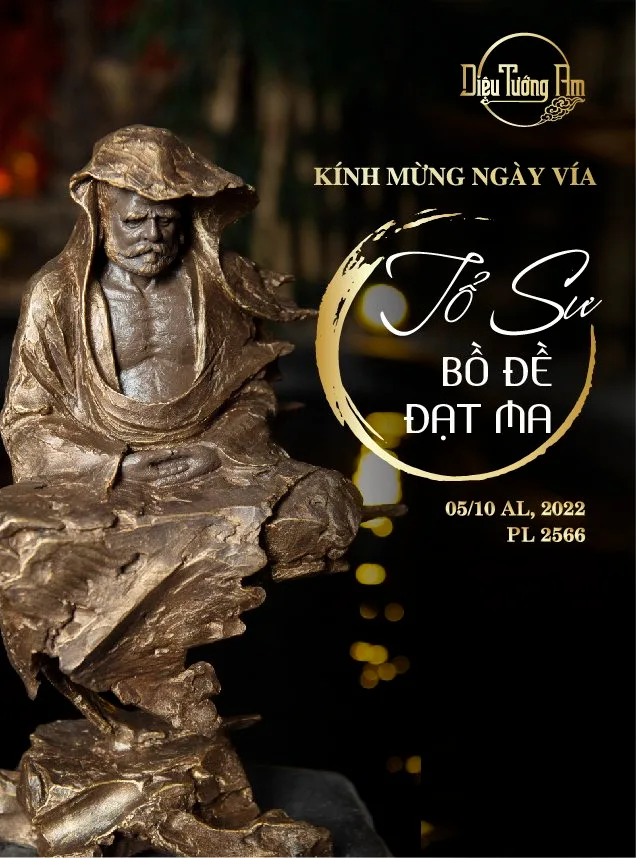
Patriarch Bodhidharma was born roughly 1,000 years after the Buddha's Parinirvana. He came from South India, being the third prince, son of King Bồ Hương Chí. Even as a child, he possessed remarkable intelligence and an unmatched gift for eloquent discourse. After his father's passing, he resolved to renounce worldly life in pursuit of the Way, becoming a disciple of Patriarch Prajñātāra, the 27th Patriarch in the direct lineage of Indian Chan.
After years of study and devoted service to Patriarch Prajñātāra, he received the transmission of the mind-seal and became the 28th Patriarch of Indian Chan. Following his master's passing, in accordance with his teacher's instructions, Bodhidharma journeyed to China to teach and liberate beings. He arrived in China in the year 520, during the reign of Emperor Liang Wu of the Liang dynasty. Emperor Liang Wu invited him to the palace to discuss the Dharma, but sensing that the conditions for a deeper teaching had not yet ripened, Bodhidharma quietly took his leave of the emperor rather than remain at court. He then traveled to Luoyang, eventually settling at Shaolin Temple on Mount Song.
There, Bodhidharma devoted himself wholly to meditation, sitting in silent contemplation facing a wall for nine years without uttering a single word. None among the monastic community could fathom him, and so they called him "the Brahmin who gazes at the wall." At that time, a monk named Shenguang, having heard of Bodhidharma's renown, resolved to seek him out and study under him. Upon reaching the Patriarch, Shenguang made his request and bowed with full reverence, yet Bodhidharma neither turned to face him nor spoke a word. Undeterred, Shenguang knelt there in steadfast devotion, remaining still even as snow piled up to his knees. Moved at last by the depth of Shenguang's resolve, Bodhidharma finally spoke. Recognizing in him a rare and exceptional spirit, the Patriarch guided him toward awakening. Through this guidance, Shenguang realized the truth of ultimate reality. Bodhidharma then renamed him Huike, and from that time onward began accepting monks and guiding disciples. When the moment was ripe, he transmitted the robe and bowl to Huike, along with these verses:
/Ngô bổn lai tư độ,
Truyền pháp cứu mê tình,
Nhất hoa khai ngũ diệp,
Kết quả tự nhiên thành./
Translation:
/I have come to this land,
To transmit the Dharma and save deluded beings.
One flower blooms with five petals,
Its fruit ripens of its own accord./
Having received the transmission from Bodhidharma, Huike became the 29th Patriarch of the combined Indian-Chinese Chan lineage, and the Second Patriarch of Chinese Chan Buddhism. Bodhidharma himself stands as the First Patriarch of Chinese Chan.
After transmitting the mind-seal to Huike, Bodhidharma continued his travels to teach and guide sentient beings. When he arrived at Wumen and resided at Tianzhen Temple, sensing that his causes and conditions for teaching had come to fulfillment, he passed peacefully into Nirvana on the 5th day of the 10th lunar month in the year Bính Thìn (529 CE). It is for this reason that later generations have honored the 5th day of the 10th lunar month each year as the memorial day of Patriarch Bodhidharma's passing. His body was subsequently enshrined in a stupa at Dinh Lam Temple, on Mount Hùng Nhĩ.
Later, the envoy Tống Vân, dispatched by Emperor Ming to India, encountered Bodhidharma on his return journey at Thông Lãnh Mountain. He saw the Patriarch carrying a single sandal in hand, gliding swiftly across the waves as though flying. Tống Vân asked:
"Master, where are you going?"
The Patriarch replied:
"Back to India."
He added:
"Your ruler has grown weary of this world."
Astonished, Tống Vân bid him farewell and returned to court. Upon his arrival, he learned that Emperor Ming had indeed passed away, and Emperor Hiếu Trang had ascended the throne. He recounted his encounter with Bodhidharma to the new emperor, who ordered the Patriarch's stupa opened and the coffin examined. Indeed, the coffin was found empty, containing only a single sandal. The emperor commanded that the sandal be enshrined and venerated at Shaolin Temple. It is from this legend that later generations came to depict Bodhidharma walking upon the waves, a single sandal slung over his shoulder.
Patriarch Bodhidharma contributed immensely to the propagation of the Dharma and the liberation of beings, both in China and throughout the East at large. Through him, the authentic transmission of Chan Buddhism passed from India to China, where it flourished and bore fruit before spreading onward to Vietnam. It is for this reason that Bodhidharma is venerated in Buddhist monasteries throughout Vietnam to this very day.
In celebration of Patriarch Bodhidharma's memorial day, Diệu Tướng Am respectfully extends our wishes to all Venerable Monastics, devoted Buddhists, and valued customers:
"MAY THIS ORDINARY BODY BE TRANSFORMED INTO A BODY OF GOLDEN LIGHT,
AND MAY WHAT IS TEMPORARY BECOME A LASTING FOUNDATION!"